
Methods for solar nowcasting
There are different approaches for solar nowcasting. Most meteorological models are either local or global. We discuss numerical weather prediction methods, optical flow, and SNCAST-26, each with their own strengths and limitations.
Numerical Weather Prediction
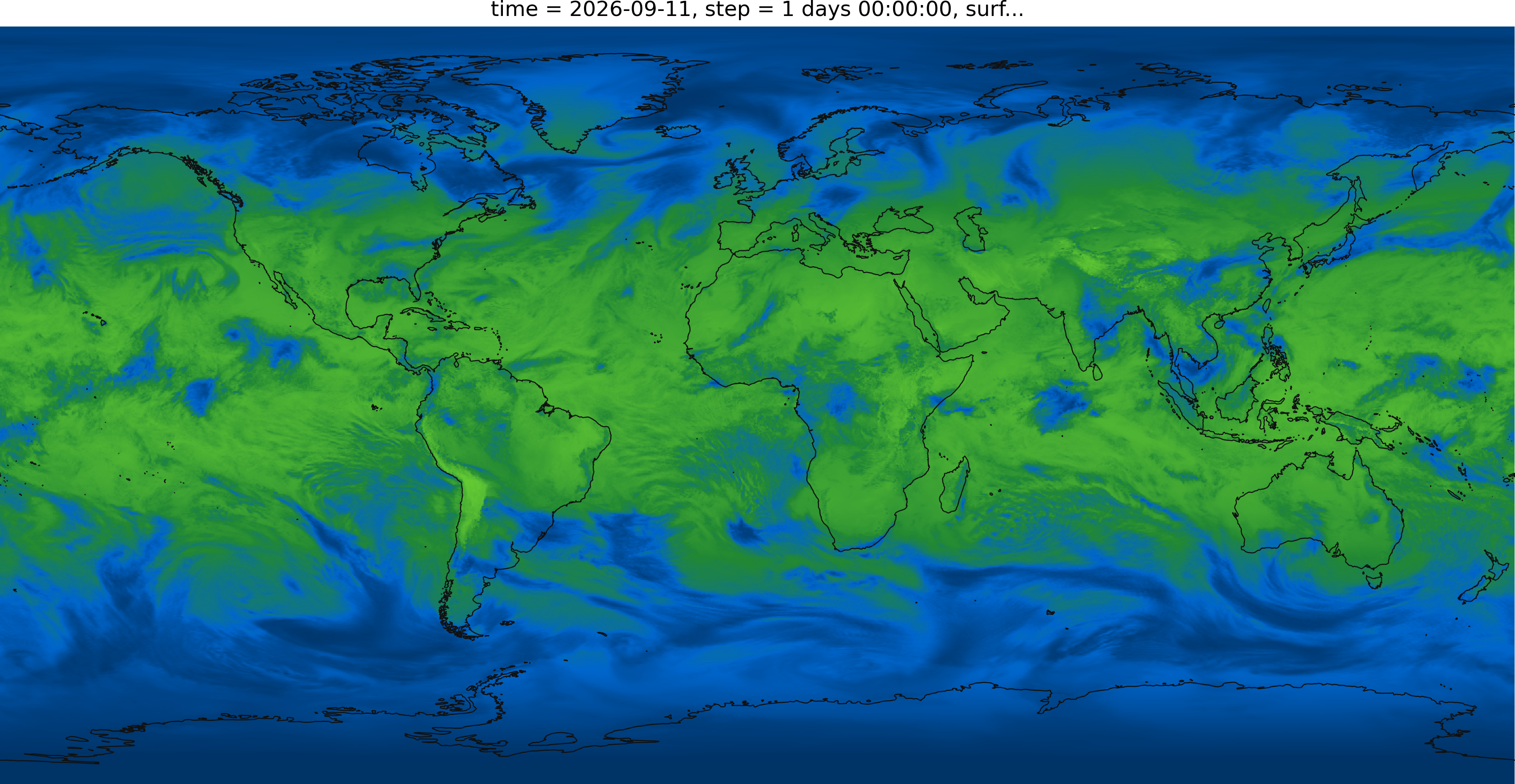
Numerical Weather Prediction models simulate the physics of the atmosphere using mathematical equations. NWP models ingest vast amounts of global atmospheric data to compute global forecast for, including but not limited, atmospheric pressure, temperature, and solar radiation.
NWP models excel at mid- to longrange forecasting (days to weeks). But due to its massive computational overhead, coarse spatial/temporal resolution and often infrequent updates make it less responsive to rapid short-term cloud dynamics needed for real-time solar balancing.
Cloud Motion Vector
Cloud Motion Vector models track the movement of clouds in sequential satellite images. The algorithm computes velocity vectors using optical flow analysis, which are then used to extrapolate future images.
This technique is exceptionally fast and efficient for ultra-short-term extrapolations (0 to 3 hours). But CMV models operate purely on the static motion vectors and therefore struggle to account for cloud genesis, dissipation, and vertical development.
SNCAST-26
SNCAST-26 bridges the gap between physics-based rigor and high-frequency agility. Our solution ingests multi-spectral satellite data, ground-based irradiance sensors, and NWP boundary conditions simultaneously.
Optimized for atmospheric patterns, SNCAST-26 can accurately predict cloud growth, dissipation, and shifting solar irradiance profiles up to 3 hours ahead with sub-10-second processing latencies and high spatial precision.